Open Internet of Things (OpenIoT)
Project Overview
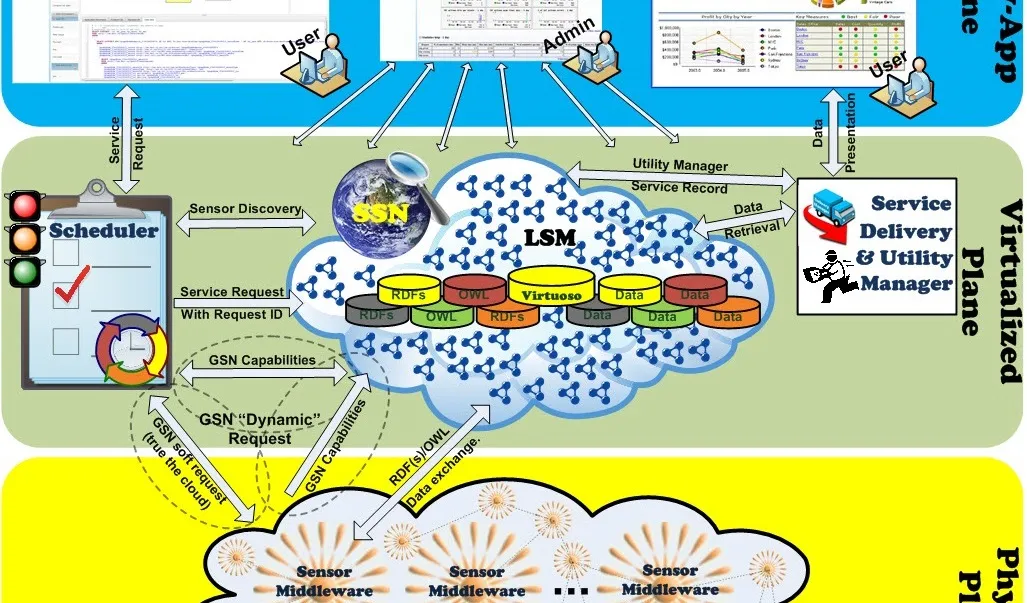
The Open Internet of Things (OpenIoT) project was an EU Framework Programme 7 initiative (2011-2014) that pioneered a cloud-based Sensing-as-a-Service (S2aaS) middleware platform for the Internet of Things. The project addressed the significant barriers posed by heterogeneous sensor hardware, communication protocols, and data formats by providing an open-source infrastructure that abstracts these complexities from developers and researchers. OpenIoT leverages W3C Semantic Sensor Network (SSN) ontologies for semantic annotation, context-aware discovery, and automatic configuration of sensors across distributed deployments. Built upon Global Sensor Networks (GSN) and Linked Sensor Middleware (LSM), the platform implements a utility-based pay-as-you-go model with support for multi-cloud environments and hierarchical data processing. The MOSDEN component extends the architecture to resource-constrained mobile devices, enabling large-scale participatory and opportunistic sensing. Real-world deployments spanned smart campus monitoring, crowd-sensing, and assisted living scenarios.
OpenIoT received significant industry recognition for its contributions to open-source IoT infrastructure. The platform was awarded the 2013 Black Duck Rookie of the Year as the best IoT open-source platform and was recognised for best semantic interoperability at the 2014 IoT Hackathon, demonstrating the platform’s versatility and impact across diverse IoT application domains.
OpenIoT served as a reference implementation for IoT standards and the European Platform Initiative. The project generated significant research impact across semantic interoperability, context-aware computing, and cloud-based sensor service delivery, influencing the development of subsequent IoT middleware architectures and open-source platforms.
Team









Funding



Repositories
openiot-platform
OpenIoT platform offering scalable IoT middleware with sensor networks, semantic discovery, service scheduling, and utility management. Includes x-GSN for data capture, LSM-Light for linked sensor metadata, security modules, QoS and CUPUS components, plus web tools for request definition.
mosden-mobile
MOSDEN is a modular Android framework for sensor collection and distribution. It provides plugin‑based wrappers for various built‑in sensors, uses AIDL for binding, and manages data via virtual sensor configurations. Includes sample plugins and Google Play services.
gsn-plugin-framework
Framework for adding plugin support to Global Sensor Networks (GSN) using JSPF. Enables runtime loading of wrapper and virtual sensor plugins via repository folders. Includes full GSN source, build scripts, templates, and sample plugins for rapid sensor integration.
dam4gsn-client
Android application for gathering data from phone sensors and streaming it to a Global Sensor Network server. Provides a UI to select sensors, set sampling rate, manage network settings, and send readings via a background service. Built with Gradle.
dam4gsn-server
Server for capturing and managing sensor streams from mobile devices. Extends the Global Sensor Network middleware, using Android wrappers for IP communication. Provides REST and SOAP endpoints, supports HBase storage, access control, and geospatial queries.
Outcomes
Dynamic Configuration of Sensors Using Mobile Sensor Hub in Internet of Things Paradigm
Proceedings of the IEEE 8th International Conference on Intelligent Sensors, Sensor Networks and Information Processing (ISSNIP), Melbourne, Australia, April 2013, Pages 473-478 (6)
Efficient Opportunistic Sensing using Mobile Collaborative Platform
Proceedings of the 9th IEEE International Conference on Collaborative Computing: Networking, Applications and Worksharing (COLLABORATECOM), Austin, Texas, US, October 2013, Pages 77-86 (10)
Connecting Mobile Things to Global Sensor Network Middleware using System-generated Wrappers
Proceedings of the 11th ACM International Workshop on Data Engineering for Wireless and Mobile Access (ACM SIGMOD/PODS-Workshop-MobiDE), Scottsdale, Arizona, USA, May 2012, pages 23-30 (8)