Smartwatch for Indoor Navigation
Project Overview
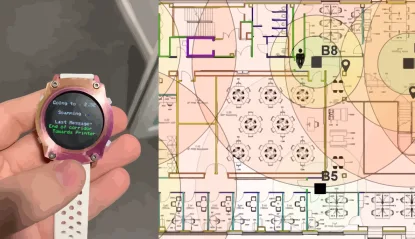
Indoor navigation remains a significant challenge because GPS signals are unreliable inside buildings. This project develops a smartwatch-based indoor navigation system that guides users through complex indoor environments using Bluetooth Low Energy beacons and onboard navigation algorithms. The prototype deploys BLE beacons across Cardiff University's ABACWS building and equips an open-smartwatch platform with Dijkstra-based shortest-path routing and RSSI-based proximity detection. The smartwatch receives signal strength measurements from nearby beacons, estimates the user's current location, and computes a route to the desired destination. Turn-by-turn directions are displayed on the watch face, providing an intuitive and hands-free navigation experience. The system is designed to be low-cost and easily deployable, requiring only commodity BLE beacons and an open-source smartwatch. User studies conducted within the ABACWS building demonstrated that all participants successfully reached their destinations using the prototype.
The successful user studies confirm the practical viability of BLE-based indoor positioning for real building environments. Combining onboard routing algorithms with commodity beacons delivers reliable guidance without requiring expensive or proprietary infrastructure, making the approach attractive for university campuses, hospitals, and other large indoor facilities.
The work has particular relevance for accessibility applications. The wrist-worn form factor and simple visual interface offer potential benefits for supporting people with communication difficulties or cognitive impairments who may find conventional wayfinding systems challenging to use in unfamiliar indoor spaces.
Team