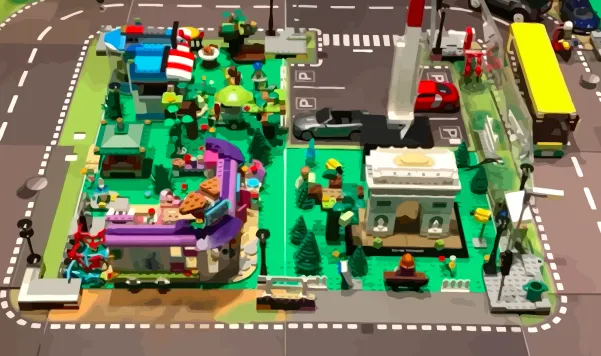
PETRAS in Lego (2023)
Project Overview
The PETRAS in Lego project developed an augmented reality-based Smart City demonstrator using physical Lego models to support public engagement with Internet of Things concepts. The demonstrator blends tangible Lego constructions representing urban infrastructure with digital AR overlays that visualise cyber-physical risks, data flows, and IoT interactions in an accessible and engaging format. Designed for use at outreach events, science festivals, and public engagement activities, the platform enables non-specialist audiences to explore how connected devices operate within smart city environments and to understand the associated privacy, trust, and security implications. The project leverages augmented reality technology to superimpose real-time information layers onto the physical Lego cityscape, allowing participants to observe simulated sensor networks, data exchanges, and potential cyber-attack scenarios in an intuitive manner that makes abstract IoT security concepts accessible to general audiences.
Funded by EPSRC through the PETRAS National Centre of Excellence for IoT Systems Cybersecurity, the demonstrator serves as both an educational tool and a research communication vehicle. It translates complex IoT security research into tangible experiences that foster public understanding of connected technologies. The project contributes to broader efforts within the PETRAS consortium to bridge the gap between academic IoT research and public awareness of cyber-physical challenges.
The Lego-based approach provides a familiar and engaging medium for communicating sophisticated technical concepts to diverse audiences. By combining physical models with digital overlays, the demonstrator encourages hands-on exploration of smart city infrastructure, helping visitors at outreach events and science festivals develop an informed perspective on how IoT systems shape urban environments.
Team




Funding


Repositories
petras-showcase
Interactive 3D smart city visualization showcasing 116 PETRAS IoT cybersecurity research projects mapped to 48 urban infrastructure types. Built with React Three Fiber, Three.js, TypeScript, and Tailwind CSS.
smart-city-base
Smart City Simulator — Interactive isometric city builder powered by Google Gemini AI. Manage a virtual metropolis with AI-generated tasks. Built with React, TypeScript, and Vite.