National Edge AI Hub for Real Data
Project Overview
The National Edge AI Hub for Real Data brings together over 40 researchers across 12 UK universities and 32 industry partners to address critical challenges in deploying artificial intelligence at the network edge. Funded by EPSRC under the AI for Real Data programme (EP/Y028813/1, £10.3M), the Hub employs a 3x3x3x2 matrix structure spanning three application domains (autonomous electric vehicles, energy security, and remote healthcare), three architectural tiers (sensor layer, edge devices, and cloud), three research workstreams (cyber-disturbance modelling, edge AI implementations, and AI-driven cyber-resilience), and two industry engagement streams including a technology incubator. The Newcastle Urban Observatory serves as the primary testbed, providing real-world sensor infrastructure for validating research outputs across diverse edge deployment scenarios.

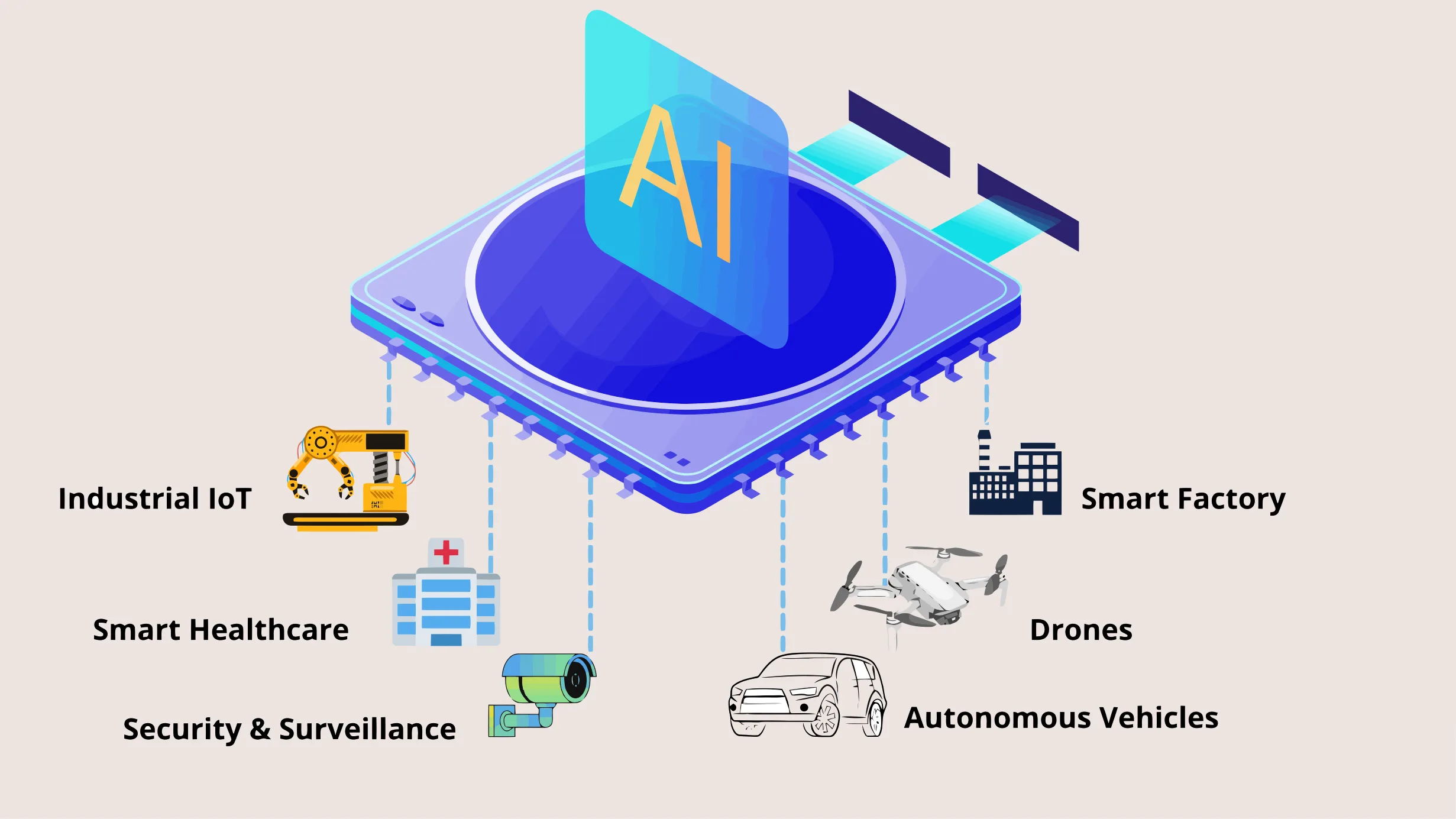
Application Domains. The Hub targets three safety-critical domains where edge AI resilience is essential. In autonomous electric vehicles, edge AI must process sensor data with minimal latency while maintaining robustness against adversarial inputs. In energy security, distributed edge nodes monitor grid infrastructure and must resist cyber-disturbances that could cascade into system-wide failures. In remote healthcare, wearable and ambient sensors generate continuous patient data that edge AI systems must process reliably, even when connectivity is intermittent or data quality is compromised.
Research Structure. The Hub’s 3x3x3x2 matrix organises research across three architectural tiers spanning the sensor-to-cloud continuum. At the sensor layer, research addresses data quality at the point of capture. At the edge tier, work focuses on lightweight AI model deployment, federated learning, and real-time inference under resource constraints. At the cloud tier, researchers develop orchestration frameworks that coordinate edge and cloud resources. Three cross-cutting workstreams address cyber-disturbance modelling for edge environments, edge computing optimised for AI workloads, and AI-driven techniques for maintaining cyber-resilience.
Testbed and Validation. The Newcastle Urban Observatory provides a city-scale IoT testbed with thousands of sensors monitoring environmental, traffic, and infrastructure conditions. This real-world deployment enables the Hub to validate research outputs against genuine data streams, cyber-threat scenarios, and operational constraints rather than relying solely on simulated environments. Application-driven validation ensures that theoretical advances translate into practical improvements for edge AI deployments.
Industry Engagement. The Hub brings together 32 industry partners including STMicroelectronics, DELL Technologies, Bose Corporation, Rakuten, and Software AG, alongside academic partners from Cardiff, Imperial College London, Durham, Southampton, Lancaster, Warwick, and other leading UK institutions. An academic-industry technology incubator accelerates the transition of research prototypes into deployable solutions, while shared benchmarks and open tools ensure that outcomes benefit the wider edge AI community.
Cardiff University Team



Funding

Hub Partners


Outcomes
Partner Universities
