Ensemble Models for Camera Trap Image Classification (2024)
Project Overview
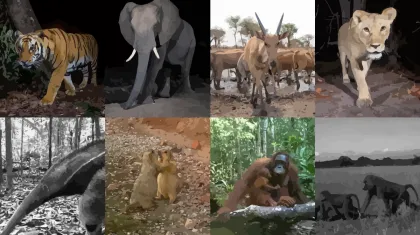
Camera traps are widely used in ecology and conservation to monitor wildlife populations non-invasively, but the volume of images they generate creates a significant bottleneck for manual analysis. Researchers and conservation practitioners often spend hundreds of hours sorting through images to identify species, count individuals, and record activity patterns. CamTrap.AI addresses this challenge by developing a multi-model artificial intelligence system that automates camera trap image classification. The project builds ensemble deep learning pipelines that combine multiple classification models to accurately identify species, detect animal activity, and filter empty or false-trigger images. By leveraging ensemble approaches, the system achieves higher classification accuracy and robustness than individual models alone, particularly for species that are visually similar or captured under challenging lighting conditions.
The project delivers end-to-end processing pipelines, trained models, and supporting tools that streamline conservation reporting workflows. By combining multiple classification models, the system reduces error rates and improves confidence in automated species labelling. These outputs enable ecologists to process large image datasets efficiently, reducing the time from data collection to actionable biodiversity insights.
Funded through HEFCW ODA, the work contributes to global conservation efforts by making AI-driven wildlife monitoring accessible to research teams with limited computational resources. The ensemble architecture is designed to be deployable on modest hardware, enabling conservation organisations in resource-constrained settings to benefit from state-of-the-art image classification without requiring expensive computing infrastructure.
Team

Repositories
camtrap-ai
Collection of scripts and pretrained models for detecting and classifying wildlife in camera-trap images. Includes Mega Detector, Marco, Google Cloud Vision, Evolving AI, and MS Species models with organized outputs.
camtrap-ai-bench
Benchmark suite for camera trap classification models. Contains sample images, ground truth labels, prediction CSVs, and evaluation notebooks. Includes weights and code for SVM, linear regression, and decision tree ensembles. Compare your own models and visualize accuracy across classes.
camtrap-ai-bulk-classifier
Flask web app for bulk camera-trap image classification. Loads 100-image batches, shows bounding boxes, supports human/empty tagging and custom labels, hashes files for duplicates, logs results to CSV, and serves a JS/HTML interface for rapid review.