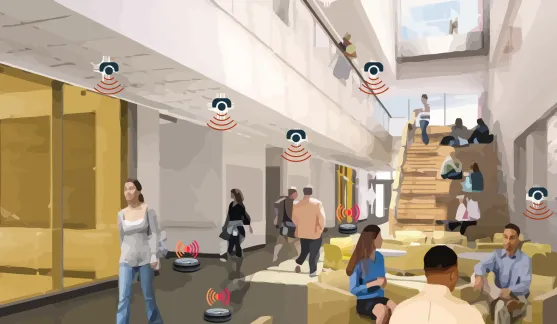
Adaptive Mobile Sensing within Buildings
Project Overview
People spend the majority of their time indoors, making the indoor environment a key factor in occupant health and productivity. Smart building systems use sensors and AI to understand occupant habits and control subsystems such as air quality, lighting, thermal comfort, and HVAC. However, the large number of static sensors required for accurate monitoring leads to high deployment costs, significant maintenance overhead, and lengthy installation times, especially when retrofitting existing buildings. This project addresses these challenges by designing a smart building platform that replaces dense static sensor arrays with mobile IoT sensors. The system comprises four subsystems covering air quality, lighting, thermal comfort, and activity recognition, coordinated through an interoperable control centre. Activity recognition is the only subsystem that collects human data, detecting occupancy levels within designated areas.
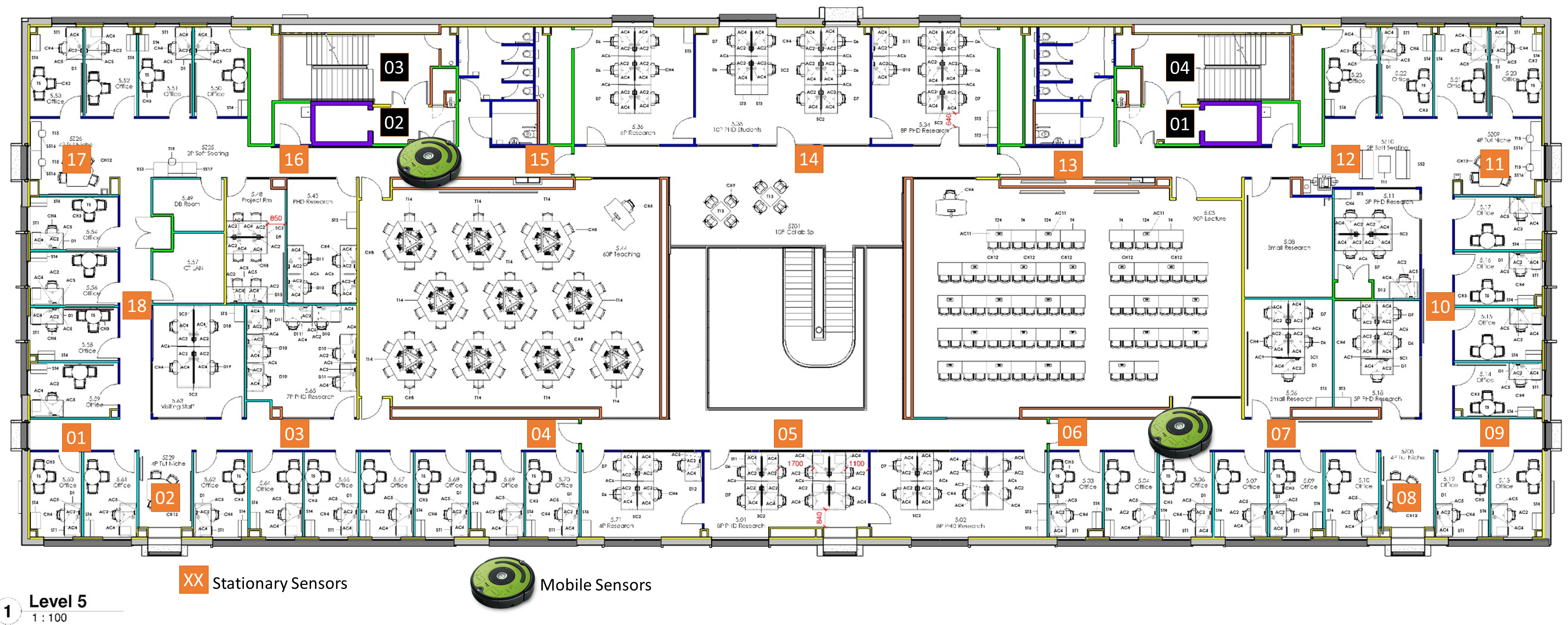
Mobile IoT sensors offer a practical alternative to dense static deployments in smart buildings. By moving sensors through the environment rather than fixing them in place, the platform reduces the total number of devices needed while still capturing comprehensive environmental data across all four monitored subsystems.
The project pursues three main research objectives. The first is to review autonomous and mobile sensing approaches used in smart environments. The second is to design a mobile sensor system based on IoT technology that achieves comparable results with fewer devices. The third is to evaluate performance trade-offs between static, mobile, and hybrid sensor configurations across anomaly detection tasks such as sustainability standard violations and comfort preference monitoring.
Team